

Pleasure as Infrastructure
On joy, rest, and why I no longer believe pleasure has to be earned
I was raised, like a lot of first-generation children of immigrants, to believe that pleasure comes after.
After the work is done. After the bills are paid. After you’ve proven, through sustained and visible effort, that you deserve a moment of rest. Pleasure was never positioned as a right. It was positioned as a reward — something you might receive if you had been disciplined enough, productive enough, useful enough to merit it.
I absorbed this so completely that I didn’t recognize it as a belief. I thought it was just how life worked.
This belief did not come from nowhere. Tricia Hersey, who founded The Nap Ministry, writes about rest as a direct act of resistance against a culture built on the forced, relentless labor of Black bodies — a culture that has never stopped expecting Black people to prove their worth through exhaustion. The logic I inherited from my parents’ survival was its own specific version of that much older inheritance. Rest was not just delayed. It was, for generations before me, made structurally unavailable.
What I didn’t expect was that this same logic — earn it before you receive it — would also govern intimacy. And it would govern something even more fundamental than that: my relationship to pleasure itself, with or without another person in the room at all.
I want to start with the relational piece, because it’s the one I understand most clearly through my own life.
I’ve been with my spouse for fourteen years. It is a partnership we choose, actively, every day — not something we fell into once and have been coasting on since. I love him. I trust the life we’ve built together.
And yet, somewhere along the way, I started to question something we are rarely allowed to question: the expectation that one person should be the sole source of all of someone’s pleasure, care, intimacy, and fulfillment for an entire lifetime. We are told this is simply the natural order of things. I don’t think it is. I think it’s a cultural agreement, not a law of nature, and I think it places an enormous, often unspoken burden on both people inside it — to be everything, to everyone, all at once, forever.
To expect that of him would be unfair. To expect it of myself, on the receiving end of a relationship trying to be infinite in every direction simultaneously, would be unfair to me too.
This is where I want to widen the lens, because the point isn’t really about romantic partnership specifically. It’s about how many different shapes depth and pleasure can take, and how rarely we let ourselves believe more than one of those shapes can be real and necessary at the same time.
I have a dear friend that I’ve known for twenty-two years, since we were young and online in the way an entire generation was young and online — building connection across an ocean through nothing but words and shared music. That bond has had decades to deepen, moving slowly, the way root systems move, arriving somewhere neither of us could have predicted when we started.
And there are newer friendships that didn’t need twenty-two years to feel that way.
People I’ve met in just the last few years where something clicked almost immediately — a rhythm, a frequency, a way of moving through the world that synced up so quickly it surprised both of us. No long history required. Just an immediate, mutual recognition that this was going to matter.
I used to think depth had to be earned through time. What I’m learning is that some bonds take decades to become what they become, and others arrive nearly whole, quickly, for reasons that resist explanation. Neither path is more legitimate than the other. None of these relationships compete with each other, or with my marriage. They are not measured against the same scarce resource.
They are different rooms in the same house — to borrow language I’ve used elsewhere in this series — each one real, each one load-bearing, each one part of the architecture that holds me.
But I want to go further than relationships entirely, because the deepest version of this belief isn’t really about other people at all. It’s about my relationship to my own senses.
We are taught, broadly and early, that the erotic and the pleasurable are taboo — dangerous, indulgent, something to be managed and minimized rather than lived in fully. This teaching doesn’t just affect how we relate to each other. It severs us from our own bodies. From the full sensory experience of being alive.
I notice, in my own life, how often I move through sensory experience without actually being present for it. Eating without tasting. Walking without feeling my feet on the ground. Listening to music while doing three other things instead of letting it move through me the way I described in an earlier essay about transmission.
And then there’s Latin dance.
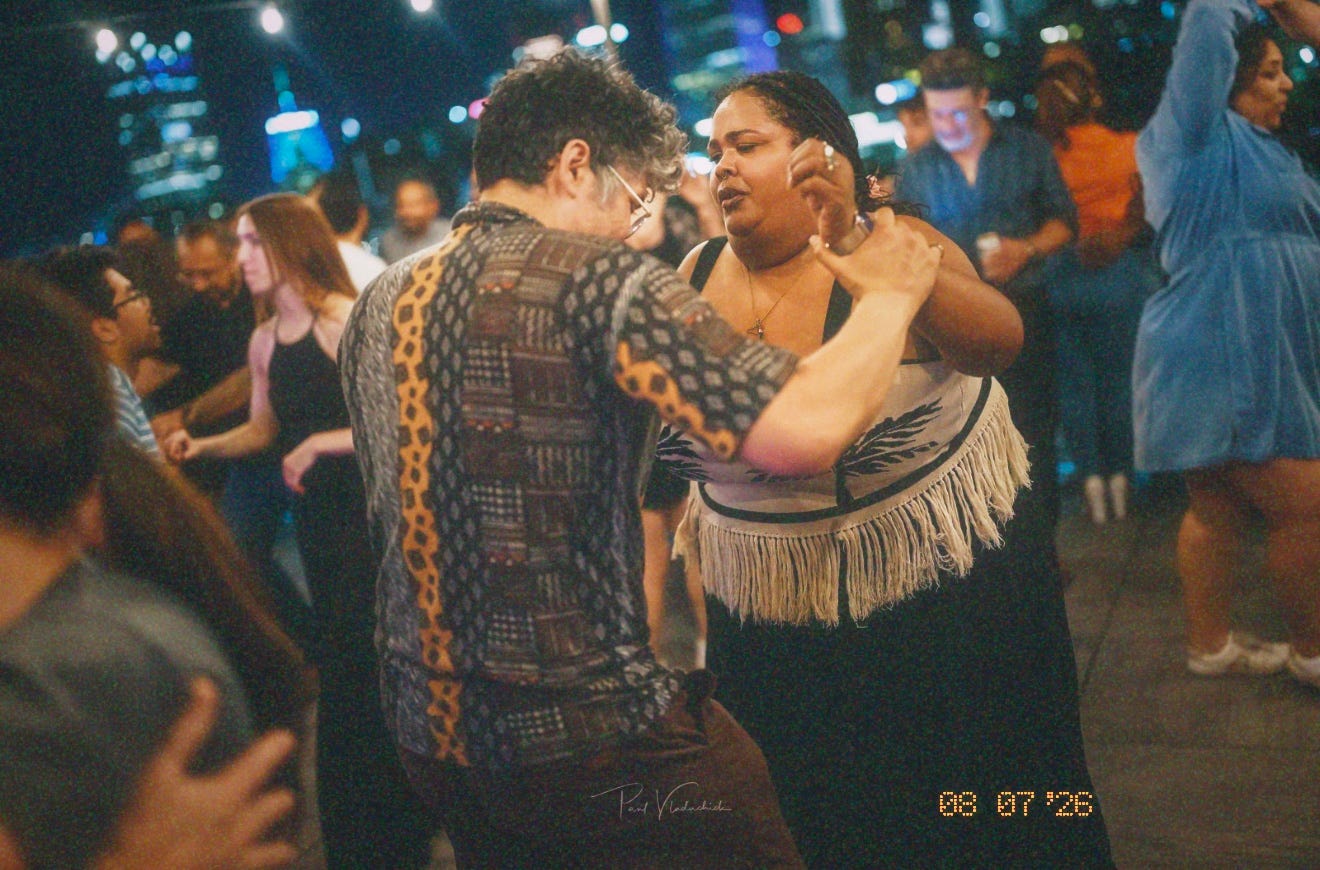
I dance two to three times a week now, not as exercise, not as a hobby I fit in when there’s time, but as something closer to a requirement for feeling whole. There is a specific quality of presence that happens on a dance floor that I cannot access almost anywhere else.
In Latin dance, there are leads and follows. I am a follow. That means my job is not to plan my next move. It’s to be so attuned, so completely present in my body, that I can feel what a lead is communicating and respond to it in real time — through pressure, through weight, through the smallest shift in someone’s frame, often before either of us has consciously registered the cue. Every lead is different. The conversation changes every single time, which means I cannot coast on memory or muscle memory alone. I have to actually be there, fully, in my body, in that exact moment, or the dance simply doesn’t work.
This is its own kind of exhilaration — not performance, not technique on display, but two people creating something together that neither of us could create alone. The music in my body before my mind has translated it into steps. The heat, the sweat, the full sensory immersion of moving in response to another person, in a rhythm that doesn’t ask permission to be felt. I am not thinking about my to-do list on a dance floor. I am not managing how I look or what I’m producing. I am simply, completely, in my body, responding to what’s actually being offered to me in that instant.
The taboo around pleasure doesn’t just restrict who I’m allowed to be close to, or how. It restricts how fully I’m allowed to inhabit my own body — to be that responsive, that present, that attuned to another person without needing it to mean something else, without needing to perform what it isn’t. Three nights a week, on a dance floor, I practice refusing that restriction.
Audre Lorde named this directly. The erotic, in her framework, is not primarily about other people. It is a way of being fully present and connected to your own feeling — a source of power and knowledge available whether or not anyone else is in the room. When that connection is severed, what’s lost isn’t just access to pleasure. It’s access to an entire form of knowing. A way of understanding what is true, what is alive, what is worth pursuing, that operates beneath language and beneath productivity.
adrienne maree brown writes about pleasure as a guide rather than a distraction — that the things which bring us alive point us toward what’s actually sustainable, and that scarcity around pleasure is usually a sign that something in the structure, not the person, is wrong.
I think the structure that says one relationship must hold all intimacy, and the structure that says the erotic and the sensory are dangerous and must be minimized, are the same structure wearing two different masks. Both of them ask us to ration something that was never actually scarce to begin with. Both of them disconnect us from forms of knowing and power that are, by birthright, already ours.
I was raised inside a logic of survival rather than abundance, and that logic extended further than I initially realized — into how much intimacy I believed I was allowed to have, from how many sources, and into how fully I believed I was allowed to inhabit my own senses at all.
My parents worked relentlessly so that I could explore dance, music, opera, and a life with room in it for beauty. If I extend that gift only to my art and withhold it from my relationships, and from my own body, I am still operating inside the scarcity their labor was meant to free me from.
Pleasure as infrastructure means treating connection, sensation, and aliveness as load-bearing; not decorative, not earned, not rationed according to category or relationship status or how much I’ve already accomplished today. It means letting a fourteen-year partnership and a twenty-two-year friendship and a brand-new connection and a dance floor at the end of a long week all be real, all be necessary, none of them in competition with each other.
I still feel the old logic activate sometimes. The instinct to minimize, to ration, to ask permission before believing I’m allowed this much aliveness.
I am practicing not doing that anymore.
I am still learning to believe I’m allowed all of it.
I am practicing believing it anyway.
One more thing.
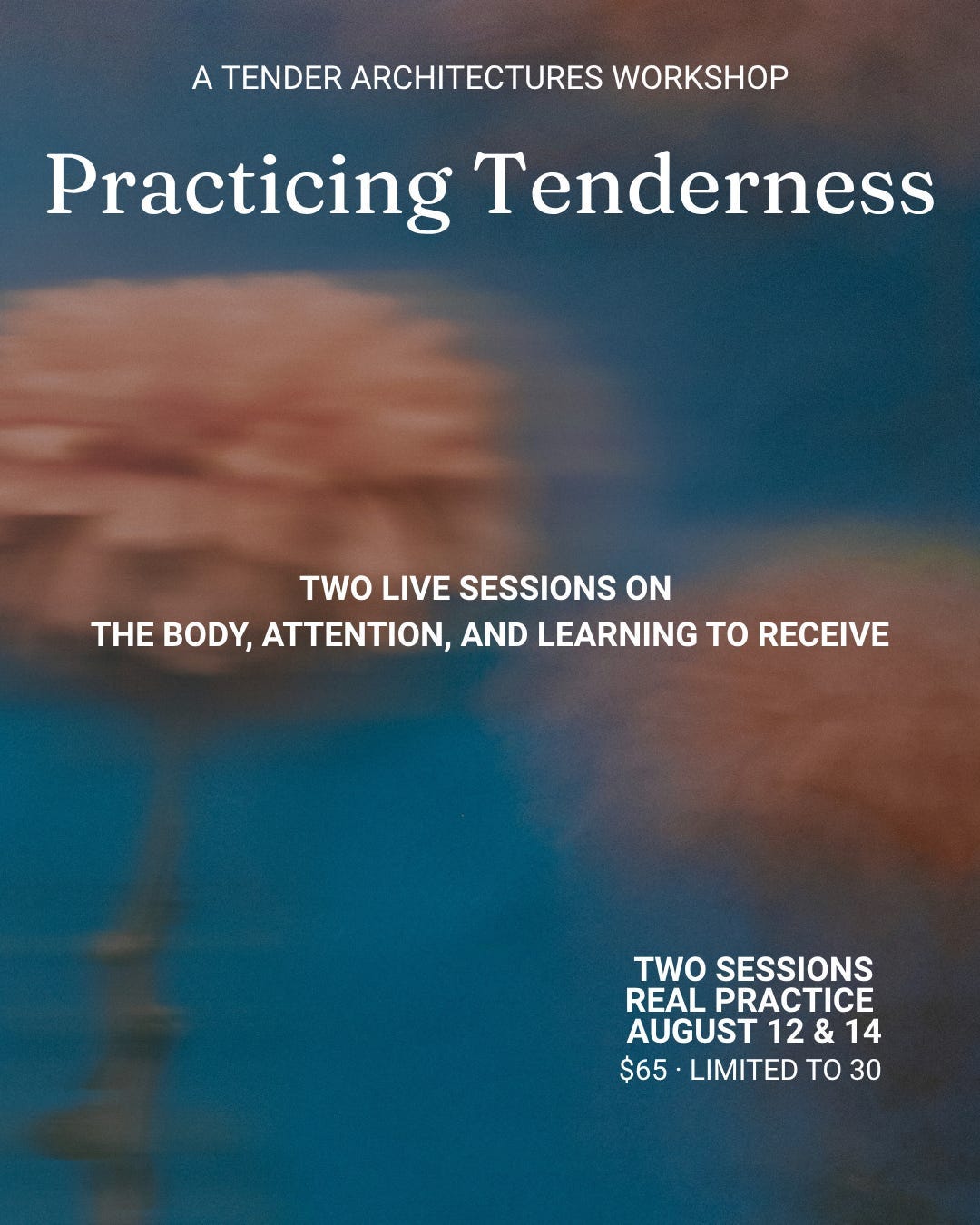
Practicing Tenderness — the two-session workshop built from this series — is still open for registration. A few spots remain.
Session 1 — Tuesday, August 12, 7:00–8:30 pm ET
Session 2 — Thursday, August 14, 7:00–8:30 pm ET
$65 for both. Limited to 30. Recording included.
[Register here →] Practicing Tenderness Registration