

Touch as Knowledge
What the body understands that the mind is still catching up to
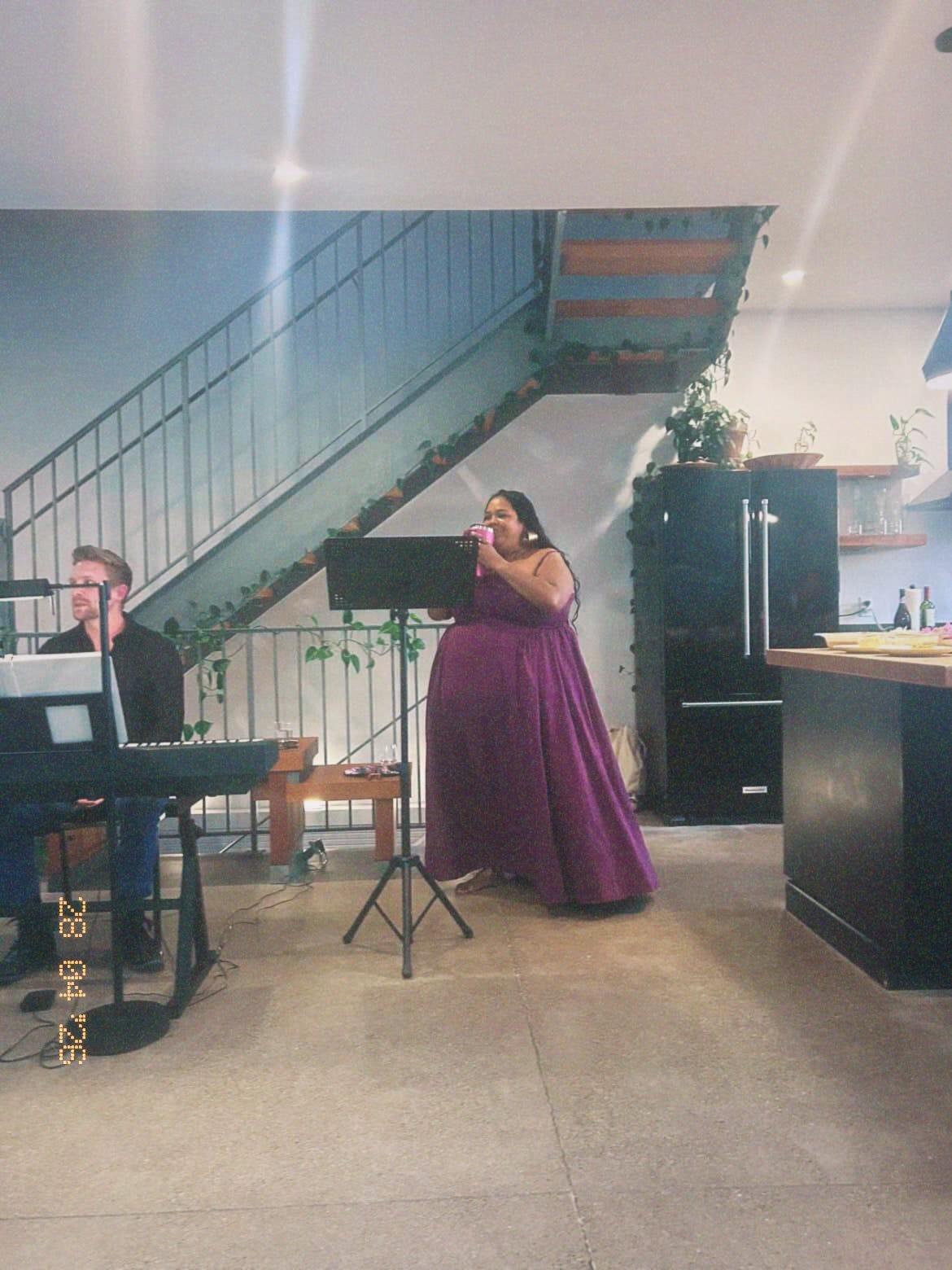
I know things I cannot explain.
I know when a room is with me before I’ve sung a note in it. Something in the air pressure, the quality of the silence, the way sound moves before it’s been asked to. I know when a collaborator is present versus when they’re performing presence — and those are completely different experiences in my body, even when they look identical from the outside. I know when a student is holding something back in a lesson, not because of what they say or don’t say, but because of where the breath stops.
I know these things the way I know anything that lives below language. Not as conclusions I’ve reasoned my way toward. As sensations that arrive before the mind has a chance to organize them into thought.
For most of my professional life, I have been quietly unsure whether this kind of knowing counts.
We live inside a culture that has decided, largely without examination, that the most legitimate forms of knowledge are the ones that can be documented, replicated, and explained in language. Data. Evidence. Argument. The kind of knowing you can point to, defend, and submit for peer review.
Embodied knowledge, the kind that arrives through sensation, through the body’s encounter with the world, through felt experience accumulated over time, gets treated as something softer. More subjective. Less reliable. Something you might mention quietly but wouldn’t lead with in a room where credibility is at stake.
I understand how this happened. The history of Western epistemology is a long argument about which kinds of knowing deserve to be taken seriously, and that argument has never been politically neutral. The dismissal of embodied knowledge is entangled with the dismissal of the people whose knowledge has most often been embodied rather than institutional — women, Black and Indigenous people, those whose ways of knowing were formed outside of universities and laboratories and written archives.
When I say my body knows things, I am saying something that has historically been treated as evidence of unreliability rather than intelligence.
I want to push back on that. Directly and without apology.
One of the most instructive examples of this erasure sits at the foundation of modern psychology.
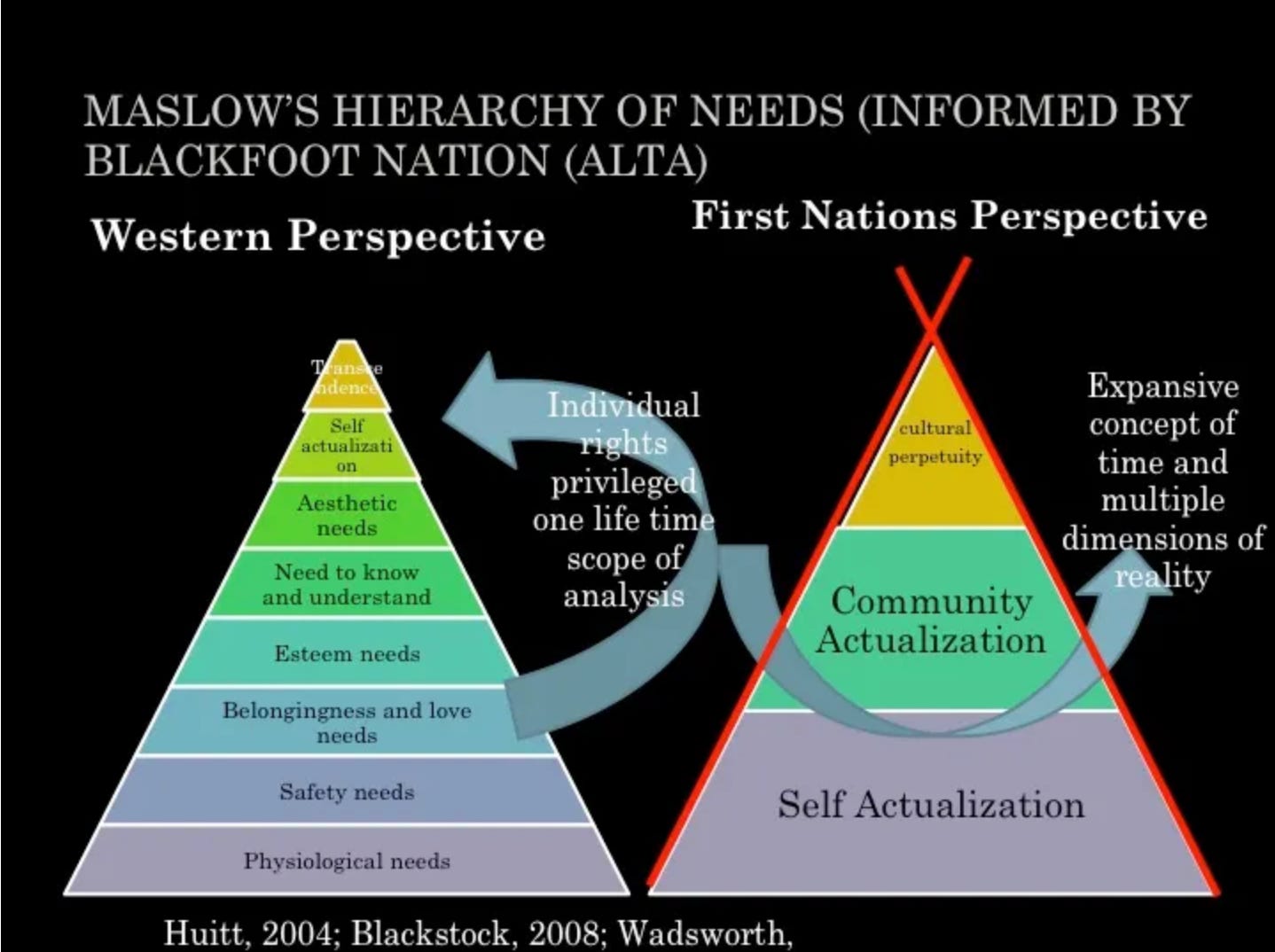
In 1938, Abraham Maslow visited the Siksika Nation — the Blackfoot Nation — in Alberta, Canada. What he encountered there was a sophisticated framework for understanding human actualization that placed self-actualization not as a personal pinnacle to be achieved but as the foundation from which community and cultural perpetuity grow. The Blackfoot understanding was relational, collective, and oriented across multiple dimensions of time, not a single lifetime but the continuity of a people.
Maslow published his hierarchy of needs in 1943. He did not credit the Siksika Nation. The pyramid, individual, linear, culminating in personal self-actualization, became one of the most reproduced frameworks in Western psychology, education, and organizational theory. The original, communal, Indigenous framework it was drawn from was not taught alongside it.
This is not a footnote. It is the pattern. Embodied, relational, collective knowledge — the kind that has always lived in communities that Western institutions did not recognize as legitimate knowledge-makers — gets extracted, individualized, and repackaged until its origins are invisible.
Opera training taught me things about the body as a site of knowledge that I don’t think I could have learned any other way.
The voice is entirely internal. You cannot see it, touch it, or directly observe it working. You learn to sing by developing an extraordinarily refined relationship with sensation; Learning to distinguish between sensations that produce one result and sensations that produce another, learning to trust what you feel in your chest and your head and your soft palate and your breath before you can hear the outcome. You are training the body to know, and then trusting what it knows.
A good teacher doesn’t tell you what to do. They create conditions in which your body can discover what it already understands. The knowledge was always there. The training is a process of learning to access it.
This is also, I learned later, almost exactly what good therapy does.
In social work training, I learned a different vocabulary for the same territory. Somatic awareness. Embodied cognition. The way trauma lives in the body rather than in narrative memory. The way healing often has to happen at the level of sensation and nervous system regulation before it can be integrated into story and meaning. The way a person can know something intellectually, can articulate it clearly, can explain it to others, and still not know it in the body. And how different everything becomes when the body finally catches up.
These two trainings — one in music, one in care — converged on the same understanding from opposite directions: the body is not a vehicle for the mind. It is a parallel intelligence. Ancient, precise, and often more honest than the stories we tell ourselves about ourselves.
There is a specific kind of knowing that happens in performance that I have been trying to find language for since I was young.
It is not the same as being technically prepared, though preparation is its precondition. It is not the same as being confident, though it can look like confidence from the outside. It is something closer to permeability. A state in which the boundary between what is inside you and what is in the room becomes, briefly, navigable. Where the music moves through you rather than being produced by you. Where you are simultaneously completely present in your body and somehow larger than it.
I learned something important about this from Palo.
Afro-Dominican Palo tradition understands the body as a site of sacred transmission, a vessel through which ancestors and spirits can speak, through which the community’s relationship to something larger than any individual can be maintained and renewed. The palero who sings does not perform. They transmit. They make themselves available to be moved through.
This is not metaphor in Palo. It is the literal description of what is happening spiritually and musically. And encountering that understanding, growing up adjacent to it, carrying it in my body before I had intellectual language for it, shaped how I understand what I’m doing when I sing in ways that Western performance training never quite reached.
The body as vessel. Knowledge as transmission. Presence as something that passes through rather than originates from.
That framework has made me a better singer. It has also made me a better therapist, a better collaborator, and a better listener. Because it asks something of me that purely cognitive knowing does not: it asks me to get out of my own way.
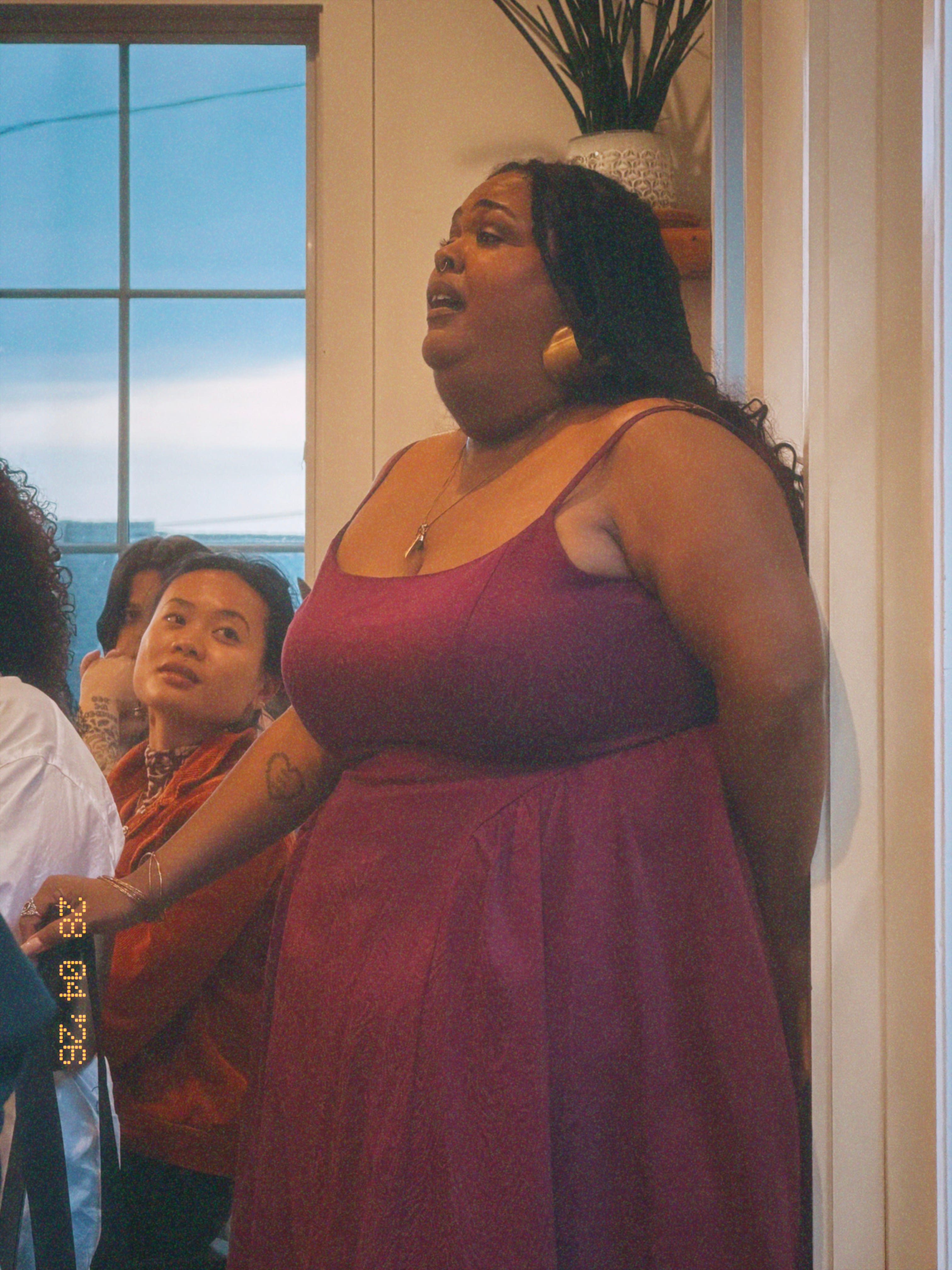
Here is what I am still learning.
I was taught, in the ways that most of us are taught, to override the body when it inconveniences the mind’s agenda. To push through fatigue. To perform steadiness when I don’t feel it. To be present when I’m depleted. To smile. To keep going.
That training runs deep. Even now, even after years of explicitly working against it, I catch myself treating my body’s signals as obstacles to manage rather than information to receive. Treating sensation as something to get through rather than something to listen to.
The practice — and it is a practice, not an achievement — is learning to pause at the sensation before moving past it. To ask what my body knows before I decide what I think. To let the intelligence that arrived first have a moment to be heard.
This sounds simple. It is not simple. It requires a quality of attention that our culture actively works against, that our institutions are not designed to support, that our professional training rarely models, and that our relationships often don’t have room for.
But I keep coming back to what becomes possible when I do it. How different the work is when I’m working from the body’s knowing rather than around it. How much more honest the singing. How much more present the care. How much more available I am to actually be in the room I’m in rather than managing my way through it.
Touch as knowledge. Sensation as intelligence. The body as the first and most honest responder.
This is where Tender Architectures begins — not as a metaphor but as a practice. Not as something to think about but as something to return to, again and again, until it becomes the ground rather than the exception.
The body already knows. The work is learning to trust it.